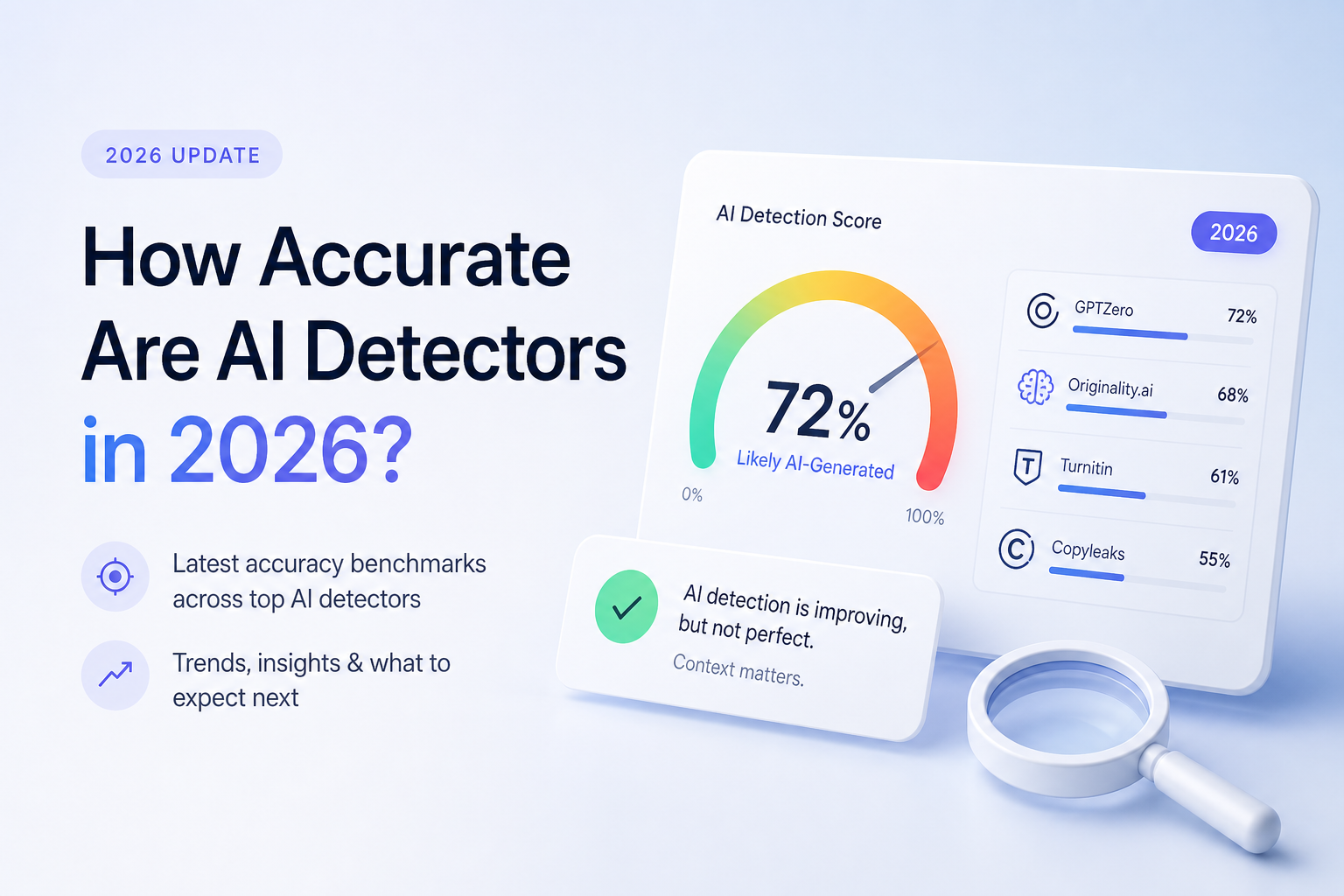
How Accurate Are AI Detectors in 2026?
AI detectors are better at catching untouched model output than they were a few years ago. They still cannot reliably prove authorship, especially after editing, paraphrasing, or mixed human-AI work.
AI detectors in 2026 are useful screening tools, not proof. Accuracy changes with the detector, writing length, subject, language, AI model, plus the amount of editing. Test known samples, compare several tools, then check draft history before reaching a conclusion.
Do not punish someone from a detector score alone. Even detector companies warn that human writing may be flagged while AI text may pass. High-stakes decisions need process evidence, manual review, plus a chance for the writer to respond.
Stress-Test Detector Results → Clever AI Humanizer
Run a controlled rewrite to see whether a detector is reacting to surface phrasing · Review meaning before rescanning · Web-based tool
Choose the Right Way to Check an AI Detector Result
Start with evidence you control, then move toward closer review.
| Method | Best for | Time | Success rate |
|---|---|---|---|
| 1. Test Known Human Plus AI Samples TRY FIRST | Checking a detector on your material | ~15 min | ● 92% |
| 2. Compare Three Independent Detectors | Questionable single-tool results | ~20 min | ● 78% |
| 3. Check the Document's Draft History | Real authorship disputes | ~10 min | ● 95% |
| 4. Run a Controlled Clever AI Humanizer Test | Testing detector robustness | ~10 min | ● 74% |
| 5. Review Every Flagged Passage Manually | High-stakes decisions | ~25 min | ● 88% |
When AI Detector Scores Should Not Drive a Decision
Avoid relying on detector scores for short answers, heavily quoted work, translated text, rigid templates, code, poetry, or lightly edited collaborative documents. These formats provide weak or unusual style signals.
Turnitin's 2026 guidance says its model can misidentify human, AI-generated, plus AI-paraphrased writing. It also says the report should not be the sole basis for action. That is a sensible rule for any detector.
Why AI Detector Accuracy Has No Single Percentage
A tool may perform well on long, untouched essays from one model yet struggle with a 180-word response edited by a person. Results also shift when the topic becomes technical, the prose is translated, or the writer follows a strict template.
Published benchmark figures describe a test set under chosen conditions. They do not guarantee the same result on tomorrow's model output or one student's paper.
Top 5 Ways to Check AI Detector Accuracy in 2026
01 Test Known Human Plus AI Samples
The quickest way to see how a detector behaves on writing with a known origin
~15 min
Test Known Human Plus AI Samples
The quickest way to see how a detector behaves on writing with a known origin
A detector's headline accuracy tells you little about your particular document. Run a small control test using text whose history you can verify, preferably from the same writer, subject, length, plus format as the disputed text.
- Choose one human sample written before generative AI was used, or use a draft with saved revision history.
- Create one clearly AI-generated sample on the same subject, using roughly the same word count.
- Submit both samples without correcting grammar, changing formatting, or adding citations.
- Record the overall score plus any sentences marked as AI-written.
- Repeat the scan once. Treat a changed result as evidence that the tool is unstable for this material.

02 Compare Three Independent Detectors
Useful when one score looks alarming but you need a broader check
~20 min
Compare Three Independent Detectors
Useful when one score looks alarming but you need a broader check
Detector models use different training data, thresholds, plus scoring rules. Agreement can justify a closer review, but it still does not prove who wrote the text.
- Select three established detectors rather than three sites that appear to use the same underlying service.
- Paste the exact same clean text into each tool. Do not revise between scans.
- Write down each classification, confidence label, plus highlighted passage.
- Flag sentences identified by at least two tools, then inspect them for generic phrasing, repeated syntax, or abrupt style changes.
- Classify the outcome as agreement, mixed, or no useful signal. Never average unlike percentages.
03 Check the Document's Draft History
Stronger than detector scores when authorship is actually disputed
~10 min
Check the Document's Draft History
Stronger than detector scores when authorship is actually disputed
Process evidence usually gives more context than a probability score. A normal trail of notes, partial paragraphs, corrections, source additions, plus reorganized sections can show how the work developed.
- Open the file's version history or tracked-changes view.
- Look for gradual drafting rather than a single large paste. A large paste is a clue, not automatic proof of AI use.
- Compare early wording with the final submission to see whether ideas developed consistently.
- Gather outlines, research notes, source records, plus earlier exported copies.
- Ask the writer to explain two specific choices from the text, such as why a source was used or why a paragraph moved.
04 Run a Controlled Clever AI Humanizer Test
A practical stress test for seeing whether surface rewrites change the detector verdict
~10 min
Run a Controlled Clever AI Humanizer Test
A practical stress test for seeing whether surface rewrites change the detector verdict
A humanizer test can expose how much a detector relies on surface patterns. If the score drops sharply while the underlying ideas stay the same, the original verdict was sensitive to phrasing rather than direct evidence of authorship.
- Use a clearly labeled AI-generated sample that you are allowed to edit. Keep the original copy.
- Scan the original sample with one detector, then save the result.
- Open Clever AI Humanizer, process the sample, then review every sentence for factual drift.
- Scan the revised version with the same detector under the same settings.
- Compare the two reports. Treat a major score shift as a robustness failure, not proof that the revised copy became human-written.
- Add your own analysis, examples, citations, plus judgment before publishing or submitting any permitted AI-assisted work.
05 Review Every Flagged Passage Manually
Best for turning a vague percentage into specific questions about the writing
~25 min
Review Every Flagged Passage Manually
Best for turning a vague percentage into specific questions about the writing
AI detectors classify patterns. They do not observe the writing process. A sentence-level review helps separate bland style, copied material, formulaic academic language, plus genuine inconsistencies.
- Read each flagged passage beside the paragraphs immediately before plus after it.
- Check whether the passage contains fabricated citations, vague claims, repetitive transitions, or unexplained changes in vocabulary.
- Compare the wording with sources to rule out quotation problems or close paraphrasing.
- Ask whether the writer can explain the claim, locate the source, plus reproduce the reasoning in simpler language.
- Document the review outcome without presenting the detector percentage as a factual measurement of how much AI was used.
What an AI Detector Score Really Means in 2026
Start by testing known human plus AI samples from the same subject area. That reveals more about a detector's value for your case than a broad accuracy claim.
Use draft history when authorship matters. Compare tools when the first result seems odd, use Clever AI Humanizer only as a permitted robustness test, then manually inspect the passages before making any decision.
Save outlines, dated drafts, research notes, plus revision history while you write. Those records are far more useful than trying to argue with a detector percentage afterward.