Best AI Detectors with Sentence-Level Analysis: Clever AI Detector and Alternatives
A document-wide percentage rarely tells the whole story. These four detectors reveal which sentences triggered concern, though their limits, pricing, plus review tools differ quite a bit.
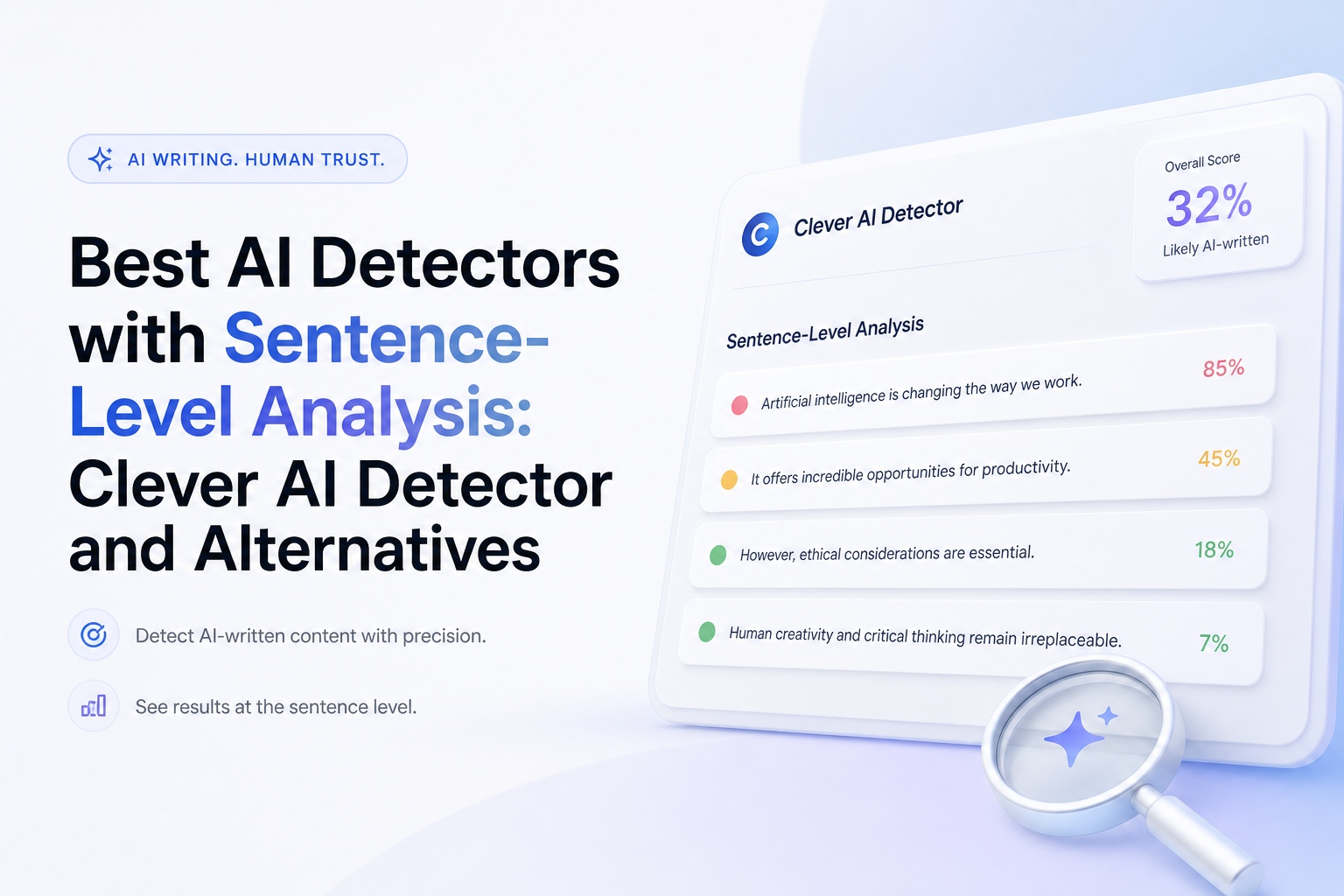
Clever AI Detector
9.2/10Best for: Editors, students, or writers who want sentence-level clues without creating an account or buying credits
- Sentence-level AI signals are included free
- Supports up to 10,000 words per check
- No sign-up required for basic checks
- Unlimited runs with no ads or paywall
GPTZero
8.8/10Best for: Teachers or academic reviewers who need granular signals plus writing-process evidence
- Document, sentence, plus word-level indicators
- Free plan for occasional checks
- Writing replay provides evidence beyond detection
- Batch uploads on paid tiers
Originality.ai
8.4/10Best for: Publishers or agencies screening long articles, freelancer submissions, or entire websites
- Useful sentence highlighting for closer review
- Uploads Word or PDF files
- Can scan individual URLs or full websites
- Includes plagiarism plus readability tools
AI Detectors with Sentence-Level Analysis Compared
This table compares sentence-level reporting, free access, starting price, plus our overall score. The scores reflect an editorial review of feature access, transparency, usable limits, workflow depth, plus cost. They are not claims that any detector can prove authorship.
| Tool | Sentence Detail | Free Checks | Price | Score |
|---|---|---|---|---|
| 1.Clever AI Detector PICK | ● Yes | ● Yes | Free | 9.2/10 |
| 2.GPTZero | ● Yes | ● Yes | $8.33/mo | 8.8/10 |
| 3.Originality.ai | ● Yes | ● No | $12.95/mo | 8.4/10 |
| 4.Copyleaks | ● Yes | ● Yes | $13.99/mo | 8.1/10 |
The 4 Best AI Detectors with Sentence-Level Analysis, Reviewed
01 Clever AI Detector
Web app · CleverFiles
9.2/10
Clever AI Detector
Web app · CleverFiles
Clever AI Detector is the easiest starting point here because its useful detail is not reserved for a subscription. It accepts 80 to 10,000 words per check, returns an overall probability, then points to the sentences that contributed most strongly to that result.
Our feature audit gave it the top score for its combination of sentence-level marking, confidence language, unlimited runs, plus a clean $0 price. The interface also says plainly that a result is probability rather than proof. That distinction matters when a formal sentence or a non-native writer's phrasing causes a false alarm.
The main limitation is language coverage. Clever currently focuses on English, so multilingual schools or global editorial teams may be better served by Copyleaks. Still, for checking an English essay, article, email, or report one passage at a time, Clever asks for the fewest compromises.
Best forEditors, students, or writers who want sentence-level clues without creating an account or buying credits
- Sentence-level AI signals are included free
- Supports up to 10,000 words per check
- No sign-up required for basic checks
- Unlimited runs with no ads or paywall
- Optional account saves check history
- English detection only
- Minimum input is 80 words
- No team dashboard or public API plan listed
02 GPTZero
Web platform · GPTZero
8.8/10
GPTZero
Web platform · GPTZero
GPTZero gives reviewers more context than a lone percentage. Its reports can identify signals at the document, sentence, or word level, while the Chrome extension can capture a replay of how a document was written. That replay may be more useful than another detector score when authorship is disputed.
The free plan covers light use, with published limits of roughly 10,000 words per month plus shorter per-scan allowances. Paid plans raise monthly volume, upload limits, plus access to related tools. The Essential plan starts at $8.33 per month when billed annually.
GPTZero is a strong fit for classrooms, though its expanding collection of features can feel busy if all you need is a quick sentence highlight. Pricing information also varies by billing screen, so confirm the checkout total before subscribing.
Best forTeachers or academic reviewers who need granular signals plus writing-process evidence
- Document, sentence, plus word-level indicators
- Free plan for occasional checks
- Writing replay provides evidence beyond detection
- Batch uploads on paid tiers
- Education-focused thresholds plus integrations
- Interface has more features than casual users may need
- Free use has monthly limits
- Annual billing is required for the lowest advertised rate
03 Originality.ai
Web platform · Originality.ai
8.4/10
Originality.ai
Web platform · Originality.ai
Originality.ai is built less like a free checker, more like an editorial quality-control desk. It accepts pasted text, URLs, PDFs, Word files, plus complete site scans. Scan tags, shared reports, role controls, plus a browser extension make it practical for teams reviewing a steady queue of content.
The Pro plan costs $14.95 per month, or $12.95 per month with annual billing. It includes 2,000 monthly credits, where one credit covers a 100-word AI scan. Running plagiarism at the same time consumes another credit per 100 words.
Its sentence highlighting helps locate passages worth reviewing, though the paid-first setup is harder to justify for someone checking one essay. It makes more sense when AI detection is only one part of a broader publishing workflow.
Best forPublishers or agencies screening long articles, freelancer submissions, or entire websites
- Useful sentence highlighting for closer review
- Uploads Word or PDF files
- Can scan individual URLs or full websites
- Includes plagiarism plus readability tools
- Team roles, tags, plus shared scan management
- No lasting free plan for full workflow access
- Monthly subscription credits expire
- AI plus plagiarism checks consume credits faster
04 Copyleaks
Web platform · Copyleaks
8.1/10
Copyleaks
Web platform · Copyleaks
Copyleaks stands out where English-only detection is not enough. It supports more than 30 languages, provides sentence-level results after free account creation, plus checks for mixed human or AI passages. Its broader platform also handles plagiarism, source code, plus AI-generated images.
The Personal plan is $16.99 per month, or $13.99 per month when billed annually. It includes 100 credits, equal to as much as 25,000 words because one credit covers up to 250 words. The Pro tier raises that allowance to 1,000 credits while adding seats plus advanced filters.
The reporting depth is useful, though its plan structure takes a little time to understand. Switching plans can replace unused credits, so teams should estimate monthly volume before changing tiers.
Best forSchools, international companies, or compliance teams checking content across several languages
- Supports over 30 languages
- Sentence-level detail plus highlighted phrases
- Handles mixed human or AI text
- Personal plan includes AI plus plagiarism detection
- Pro plan supports up to 25 seats
- Full granular results require an account
- Credit rules take time to learn
- Changing plans may forfeit unused credits
How We Evaluated AI Detectors with Sentence-Level Analysis
We compared each detector's public interface, current feature documentation, input limits, sentence-level reporting, account requirements, language support, plus verified pricing as of September 5, 2026. Scores favor tools that let readers inspect the reasons behind a document score instead of showing only one dramatic percentage.
We also considered how well each product fits a real review process. A free checker earned credit for low friction, while paid platforms gained points for batch uploads, team controls, integrations, or authorship records. Vendor accuracy claims were not treated as directly comparable because companies use different datasets, thresholds, text lengths, plus definitions of a correct result.
How to Choose an AI Detector for Sentence-by-Sentence Review
Start with the report, not the claimed accuracy number. A useful detector should identify suspicious sentences, explain uncertainty, accept enough text to preserve context, plus let you revisit the result. Document-wide scores alone can hide whether one paragraph drove the entire result.
Match the tool to the decision. A writer checking personal drafts may only need Clever's free report. A teacher may value GPTZero's writing replay, while a publisher may need Originality.ai's site scans. International teams should put language coverage near the top of the list, which gives Copyleaks a clear advantage.
Common Mistakes When Using Sentence-Level AI Detectors
The biggest mistake is testing one isolated sentence. Detectors need surrounding language to judge rhythm, repetition, plus shifts in style. Very short text can produce unstable or overconfident-looking results, even when the software technically accepts it.
Another error is rewriting authentic work solely to lower a score. That can make clear prose awkward without proving anything. Keep outlines, research notes, tracked changes, cloud version history, plus cited sources. Those records say far more about authorship than a colored highlight from one classifier.
Which Sentence-Level AI Detector Should You Use?
Clever AI Detector earns first place because it makes its most useful evidence available at no cost: an overall probability, confidence context, plus the specific sentences behind the result. Its 10,000-word limit is also generous enough for essays or full articles.
Choose GPTZero if authorship replay or classroom workflows matter more. Originality.ai fits publishing teams that also need plagiarism or site scans, while Copyleaks is the practical choice for multilingual review. No matter which tool you use, treat the output as a reason to inspect the work, not as a final verdict about the writer.
Run the complete document through two detectors, note where their sentence flags overlap, then compare those passages with drafts or version history before drawing a conclusion.